The Thinking Horsetrainer

Showing posts with label Clinton Anderson. Show all posts

What does Cesar Millan have to do with horse training?

Published by Cari Zancanelli under , , , , on 12:06 PM

Changing the way horse people think about horse training


I read an article yesterday called "The Dog Whisperer Should Just Shut Up" by Curtis Pesmen (there is a link below). The article talks about Cesar's methods and how they are dominant and aggressive and the fact that he has no "credentials". So, what does Cesar Millan, "The Dog Whisperer" have to do with horse training?  In one sense, everything.  His dog training methods are nearly identical to Clinton Anderson's and most traditional horse training.  It's all about dominance, being the "pack leader", using the animals' "own language" to become part of the group and control them. What's wrong with that?  I mean, using the animal's own language sounds somehow intuitive, doesn't it? And what about the fact that most clinicians do NOT have any credentials from a college or university, but merely have put in many hours with other horse trainers?  What does that say about the horse training industry?  It says we value experience more than education, but I don't think anyone will be speaking out against those trainers publicly. 


If a horse trainer has won some competitions, has a TV show and a DVD training series, travels around giving clinics and is "good with horses", those are considered credentials enough. How many of them have degrees in Equine Science?  How many of them know any theories about animal or horse behavior specifically?  I don't know.  None of the clinicians I know of has ever mentioned any credentials besides...other horsemen (if that. Many say they came up with it all on their own).  What I'm talking about here are the more "Western" style clinicians, the ones who are really making the big bucks and marketing themselves.  


On the other hand, the dressage folks certify instructors and judges and have rules that govern many aspects of the sport.  They lean towards education and rules. Those at the highest level of the sport still have coaches and take riding lessons.  That doesn't make it perfect, but at least there is a group of people overseeing things that makes sure someone who teaches and trains knows what they are doing. 


Aside from the fact that many clinicians and backyard trainers are not educated, the overall (English or western) attitude is that "if it's been done this way forever, it's the way to do it forever".  I bought in to all of it, too -the "joining up" in the round pen, the need to dominate the horse, the fact that they are unpredictable and dangerous.   I also bought in to the "sacking out" technique - just keep rubbing that tarp on the horse until they give in...after weeks, months, yes they might give in.  Some give in right away and others fight it, but in the end it's all learned helplessness.  Yes, that's right - they do "learn" to "accept" the tarp, but they don't necessarily like it, either. I believe that these methods only bring out aggression in horses, causing them to become more dangerous and unpredictable because we are in essence pressuring them (my mentor even used that very word - pressuring).


In the world of horse training, all of these things are widely accepted and never questioned by horse people.  The longer someone has been a "horse person", the more likely they are to accept these things and the more immune they become to what is really happening. No one who has been working with horses since they were ten years old thinks that they are mistreating a horse.  No one who has been competing horses since the age of ten thinks that they are doing anything wrong. 
That's exactly what the problem is - this is how we have ALWAYS trained horses.  Few folks wonder if it's the right way.
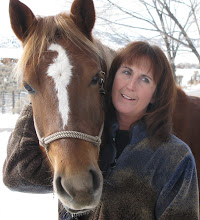
My Mom with Luna and Snickers


If more horsemen got an education such as a basic equine science degree, they would be less likely to keep traditions alive that are harmful or don't work. They might think very differently about how they do things.  They would know that many wives tales about horse behavior, disease and reproduction are just that, wives tales. If they learned merely to question what they are doing perhaps they would be more open minded about new ways of training. I know I did, and it stopped me from being "that kind" of trainer. We are all empowered trainers, empowered to do what we feel is right regardless of what the status quo is. 


 I've said it before in other posts in this blog and I'll say it again here.  Dominance is not necessary in horse training and neither is tap-tap-whack, or an aggressive "do it now" mentality. I firmly believe horses are naturally submissive and are cooperative when you treat them with respect.  It isn't necessary to force them to do things, much less do it quickly.  Give them time to think and they will get it much more quickly plus they will be "using the thinking side of their brains", to quote Mr. Anderson.  Isn't that what we want, after all?
Aggression begets aggression, every time.  Kindness, trust and respect return to you tenfold. 


If you agree or disagree I'd love to hear your thoughts! 


 Below is a link to the article about Cesar Millan:


http://www.esquire.com/features/ESQ1006-ESQ100_20-21.FINAL.rev_1?src=soc_fcbk


What road will you travel?


"All That Can go Wrong with the Best of Intentions"

Published by Cari Zancanelli under , , , , on 9:30 PM
Last night I watched a movie on OWN, a documentary called "One Lucky Elephant".  It's about a circus owner's search to find a place for his performing elephant to retire.  He bought the elephant as a baby and had someone else "break" her, and then built a circus around her.  It was even named after her.  You get the sense that he really loves this elephant and she loves him back.  There is another handler named Raul, who feeds and trains Flora also.  They show him working with her and it was appallingly obvious to me that he talked down to her.  His commands were harsh and demanding.  The tricks he asked her to do looked painful to watch. 

As I watched the movie, many things became painfully obvious.  How they interacted with the elephant is very similar to things we do to horses.  Horse training (and elephant training as well) are about putting out the fire, not encouraging it.  It's about dominance and making the horse submissive.  Yes, the techniques for that have gotten much gentler over the years, which is generally good, but they are still about dominating the animal, not allowing the animal to be itself.  They have to be what you want them to be.  I will try not to give everything away, but there is a part at the end that describes how baby elephants are trained.  The techniques are all old cowboy training methods (tying up a leg, making them lie down, etc.) and it was hard to watch!  It upset me.  Then the elephant's owner admitted that he didn't like the way the trainer was breaking his "baby", but "that's how it's done, and they have to learn to behave a certain way if they are going to be around people". 


I can't fault this man for thinking that way because I have said the same thing!  The problem is, if you aren't told that there's another way, then you can only do what you are told is "the" way.  Some will argue that you shouldn't accept these things, that you should stand up, etc. etc.  It's not so cut and dried, however. The horse industry is INUNDATED with horse training videos, each one saying that their "method" is better, more gentle, different than the last.  In truth, 98% of them use traditional training theories as their "method".  Some clinicians give credit to the old-timers that taught them, others pretend like they came up with it all on their own.  None of it is really new, and none of it is based on positive reward except clicker training, and only empowering the horse  gives the them a voice and a choice. 

If anyone spends the time to really study each "method" (I don't think most people do, they find a training "guru" and only pay homage to that person) it can take years to sort out what's really going on.  Once I learned about positive vs negative reinforcement it was easy to see that all traditional training methods use negative reinforcement.  That is, "if you don't do this I am going to increase the pressure on you somehow until you do it".  When the horse acts correctly, the punishment stops. The Punishment can be poking them with a finger, using your stick to tap-tap-tap harder and harder, anything irritating or annoying, etc.  They use reward sparingly (the "reward", we are told, is that we stop annoying the horse or whacking it).  Sounds like the way my little brother tried to get what he wanted: "I won't stop punching you until you give me your candy!"

The thing is, most people really don't want to hurt an animal. I believe that Flora's owner, David, truly loved her and she loved him too.  But the way she was trained and worked was so demeaning that it made her angry, I think.  After Flora's retirement a woman came with Raul to visit her. This woman was completely enamored of her, thought she was so beautiful and really wanted to connect with her but sensed that Flora didn't like her. Even so, they rode her and then the woman got off onto a tree branch, and Flora wrapped her trunk around the woman and beat her against the tree.  The woman fell or was thrown to the ground.  She had very serious multiple injuries and was hospitalized.  The interesting part, the part that perhaps we all understand, is what the lady said afterwards, "I didn't feel any pain.  I didn't feel anything but heartbreak."  Wow.  The owner of the elephant sanctuary, Carol Buckley, said that Flora was good example of "All that can go wrong with the best of intentions".   It reminds me of that cartoon of the Abominable Snowman, how he would pick up Daffy Duck or whoever and squeeze the life out of him while saying "I promise to love you and keep you and hold you tight forever and ever!"  Meanwhile, Daffy Duck was dying in his hands.  We love our animals to death, sometimes smothering them and not really understanding them.

Even though we love our animals and try to act with the best of intentions, things that we don't think twice about can also be harmful.  I think that many horse trainers, Clinton Anderson included, don't think that they are doing any harm.  They are taught that you must be brutal or the animal will get the upper hand!  They are dangerous and they can really hurt you and this is what justifies how horses (and other animals) are trained.  While it is true that animals can be dangerous, I tend to think that the way we try to completely control them makes them fight back more than they would otherwise. Other things, like separating babies from mamas before they are really ready, keeping a social animals apart from those of thier kind and other practices are more subtly harmful.  Many people never question what they are taught, or like me, they question it internally and search for another way on their own, while trying to fit in with everyone else.  It took me many long years to find the answer, and now I need the courage to be that way.  Horse society will look down on me, but a few choice souls will understand.

It's time we give the horse a chance, give him the choice to hang out with us and interact, or not.  We have been so sure he's dangerous we haven't looked to see if that's true.  I believe that horses are made dangerous by people, just like elephants.  They get fed up with our "holier than thou" attitude and fight back.  What if we gave them the chance to show us what they can really do, and how wonderful and trustworthy they really are?  I have found the courage to look at horses in a new way (for me), and not let others opinions sway me anymore.  I hope that whoever reads this will take a chance and do the same...  and maybe we  can make a true "horse-man-ship".

What they REALLY want to do...
Visit the website for "One Lucky Elephant"

Or the website for Ahali Elephants where Flora now lives:

On Being Gentle

Published by Cari Zancanelli under , , , on 8:33 PM
I am treading a fine line here, of which I am completely aware.  The fine line is between being a horsewoman and a bleeding heart.   In my mind, you can't be both.  A bleeding heart (for the purposes of this blog) is someone who thinks that we should have nothing to do with animals and that we in no way enhance an animal's life by being associated with them.  I am setting myself up to defend the very act of keeping horses, and that's not my purpose right now.  This is really about how we treat them after we all agree that we should have them around...  What follows is my personal opinion only.  If you agree, fantastic. If not, that's ok too.  If I make you angry, you may want to consider where that anger is coming from. 

I used to work with a woman who owned 7 dogs, a cat, 2 birds and 3 horses.  She once looked me in the eye and told me that she thought it was wrong for people to keep animals!  Her dogs all came from rescue organizations and many had "issues" and were difficult to deal with.  She didn't want to take the time to train them.  When I suggested humane means of training (i.e. the clicker), she responded by purchasing shock collars.  In the end I had to agree - people like her should not own animals because they are not willing to take the time to work with them in a humane way. 

Animals, whether dogs, horses, cats or hamsters, all require time just to feed them and clean up after them (obviously).  On top of that, we are keeping these animals for something more, for a connection.  I can honestly say that many of the cats I've had have chosen me.  The last one to arrive, Nemo, was sitting on my lawn near the barn, watching me intently when I first met him.  When I noticed him he ran away, then came back.  I fed him and he has never left.  He can leave whenever he wants to.  Even my horses could leave if they chose, if they were really unhappy.  At least two of them are experts at tearing down barbed-wire fencing and unlocking gates.  They could also jump out if they desired.  I mean, the fence is really just a suggestion.  Occasionally they have gotten out, wandered around the neighborhood and came running back when they saw me looking for them.  When we try to ride down the street they are afraid to go past our property...embarrassing but true!

So, we want a connection with these animals, right?  I was going to say especially women and horses, but men often also want to feel connected to their animals.  Snickers and my husband Doug have a special connection that I don't try to interfere with.  I love it, in fact.  I personally love to ride, love to be around the horses, love it when they come running to the fence.  I would like them to like me.  I don't want them to be afraid of me, and I think they want the same from me.  People who are afraid of animals or other people just make us uncomfortable.  When I first got a horse, I wanted to love that horse and vice verse.  I didn't want to make her into a slave, per say. 

Then I gradually got caught up in methods of training, and rough cowboys (not all cowboys are rough), and rough dressage people, and being "more assertive".  I lost my natural gentleness and the connection to my horse Bella.  Other things also contributed to that, like our being apart for way too long and only being able to see her a few times a month when I used to go see her daily.  I had the connection and lost it!

I lost it because I was learning to train horses and fell into some ways of training that are extremely common and can turn very aggressive and rough.  The thing is, no one thinks of them that way.  I think that people are starting to be more aware of things that are rough, but it's a slow process.  When you have an internationally recognized clinician telling you to do something, you believe in the correctness of that tool.  This is how you deal with horses, it's been done this way for years and years and years, how can it be wrong?  If your gold-medal winning dressage instructor tells you to pull back on the reins for all you're worth, and to keep pulling even when nothing good comes of it, and it feels like you're yanking the horse's jaw off, how can you question them?  It feels wrong, but this person has been given a medal by the USDF.  The next day your arms are sore from pulling and you can't help but wonder if the horse's mouth hurts even worse than your arms!

These little moments creep into your mind and build up over the years.  I kept trying new avenues, new instructors, new methods, new styles of riding.  What it comes down to is how the instructor or trainer thinks, or even if they think!  Many trainers learn their method and then go out and teach  that method and train train train that way all their lives without questioning anything!  And then there are those who pretend to be thinking, like a boss I had who said over and over, "I just can't stand dressage because they hold the reins way too tightly.  THAT'S not horsemanship in my mind!"  Then she would "train" a horse by repeating something, literally, 50 times in one session!  I watched her with a horse who wouldn't pick up a right lead.  She worked that horse on leads only for an hour, making her pick it up over and over and over.  It disgusted me.  I said nothing (this was my boss), no support of her or anything.  I felt cornered and sublimated.  I felt like the horse - having to obey and having no say but feeling completely misunderstood and wronged. 

By the time I worked for the boss I just spoke of, I had seen and tried many things that bothered me.  My boss was the final straw.  She never took me seriously (that's partly my own fault and a topic for another day) and talked down to me.  This is how many people approach horse training.  Clinton Anderson often calls the horses names - "idiot" is the first that comes to mind.  I think he is trying to be funny in a way, to make the horse seem less important.  To not let the horse be intimidating by giving him a derogatory name.  In Mr. Anderson's view, horses are nearly an enemy.  Yes, he does give them a nice rub on the forehead at times, but only after extraordinary effort on the horse's behalf.

There are a few, a very few, horse folk who can train a horse without force.  I have been unearthing them slowly over the years.  Nuno Oliveira was seemingly one, though I have yet to see him start a horse.  His writings and what I have seen of his philosophy and riding is all about tact, however, and the way he sits a horse, so still and so graceful, leaves no doubt in my mind that he accomplished much with little interference on his part.  What that means is he is not working hard, not flapping his arms or sweating or tapping away with his spurs or bouncing in the saddle.  He is like a waiter at a fine restaurant who touches you gently on the elbow, "Sir, would you like another drink?" he asks, very politely and quietly.  That is tact in riding - a gentle touch with the leg and spur, a slight wringing of the reins to bring the horse into collection. 

Then there is Frederic Pignon and Magali Delgado of the horse show Cavalia.  They wrote a book about how they train their horses called Galloping to Freedom. It's all about empowerment and play.  There is a very high level of trust between them and their horses.  I assumed by watching the show that the horses were trained to do certain routines.  They are not!  They are trained to express themselves and to interact with Frederic and Magali.  When they go onstage on any given night, they don't really know what will happen.  I find that refreshing and courageous and beautiful.  That is a true connection with a horse, and that is allowing the horse's expression and joy to become evident. 

I am also reading a book called Empowered Horses by Imke Spilker.  It is a bit long winded, but the essence is important.  It is about how to approach riding, keeping and training horses with a different attitude, much like Pignon and Delgado - playing, allowing the horse expression and choice in what is done each day.  It is difficult for me, even wanting to approach things in this way, not to head out to the arena with an agenda.  It is also difficult to figure out how to play with older horses that are so used to me being the "Master".  That old way of being has to be dismantled first, and no one has suggested how to do that yet. I will keep writing about my experiences, though, in hopes that someone else will benefit from that.  However, clicker training was a great start. 

I have to say something here about the clicker.  I still think it's wonderful and a very useful tool.  However, I also think it's important not to use it as a demand or a "have to" thing.  I think it's easy to fall into the trap of "since I am rewarding you, you'd better do this!".  We have to recognize that we can't ask that.  We can only say "please", and I would like to reward you for doing this.  You also have to clicker train with the attitude of communication being the goal more so than the thing you are training.  You must have understanding of the horse and whether or not they are enjoying something.  Even with a reward not all horses will want to do everything you think they should do.  Know when to stop, know when to change what you are doing.  Don't make it boring, or drawn out.  If they are losing interest in the exercise, it's up to you to change something. 

Communication is a two-way street.  If you want to use the clicker to communicate to them, then you should also listen to what they have to say.  They will communicate back, and if you have ever seriously worked with a horse, you know that they do!

All I am saying here is that there should be much more of a place for gentleness in working with horses.  You will accomplish so much more than if you demand for things to happen and your will find that you develop a deeper connection with your horse.

On "Lightness" and the Master....Nuno Oliveira

Published by Cari Zancanelli under , , , , on 9:03 PM
Finally, I am writing about the thing that I have been trying to write about for a long time.  I have no idea why it has taken me this long to write any of this.  I guess I felt that an explanation was needed, a history of how I arrived at this end.  Maybe it's just because so many horse people around me are of the opposite feeling about how to train horses that the tendency to defend my views becomes more important than the facts. 

In reality it's very simple;  I am tired of being something I'm not.  I am not overly assertive, aggressive or hard.  I don't like the "do this now" school of horse training.  I have expressed my respect for Clinton Anderson, but in reality his method of training is more like a battle.  Actually it's more like boot camp for horses.  The things he says to them (which I can't remember offhand but he said things like "he's a monster" or something similar) are always negative.  He is always having to protect himself because the horse might do something to harm him.  I finally wondered - why?  Horses can hurt you, it's true, however since I changed my training methods I have only had cooperation and have never felt safer. 

Horses are flighty and young horses spook and are afraid of things, for sure.  In my world this is where the danger lies.  If you are working with your horse in a positive way, in a way that they enjoy, the danger of them coming after you or striking out is very low.  They have begun to understand what I am asking for.  They have started to ask for training time, not to avoid it.  They get upset when I don't work with them.  We have fun!  I am trying to get them to "play", to spend time together with me that is purely time just to "be".       Some of you will scoff right here and sign off.  I dare you to keep reading.  I dare you to reconsider how you look at your horses and how you train them. 

So many people want a relationship with their horses, not the least because many horse owners are women and women crave connection.  I think men also crave a connection but they don't talk about it.  Then there are men like Nuno Oliveira.  For everyone who follows a western style clinician, for everyone who believes that dressage must be done with a tight rein (or a tight contact), for everyone who is constantly fighting with their horse to accomplish things, please look up Nuno Oliveira.  There are others, but the way he rides is such a pleasure to watch it will move you.  If you belong to Giddyupflix.com you can rent several DVDs about him that show him riding.  Sadly, he has passed away as has his son, Joao who was also very good. 

These videos inspire me and show that the ultimate is possible - riding a horse as an art form.  Not as a submissive, obedient soldier who acts without brilliance but a horse that dances with it's own joy.  The horses he rides float effortlessly, dancing in piaffe and passage with true action.  They pick their feet up in rhythm and grace.  They make the last  Olympic competitors look dull and mechanical.  I'm sure that there are other horse people out there that have noticed the lack of true grace in those "German" trained dressage horses.  It's not pretty to watch because it's too labored.

I recently watched the DVD "Nuno Oliveira - 20 Years Later".  I have watched it several times now and have taken notes.  I have also just read Galloping to Freedom" by Magali Delgado and Frederic Pignon which advocates "empowered horsemanship".  I feel as if I have finally come home to the training I've always wanted to do.  The kind of training that brings pleasure to the horse and the rider.  The kind of training that allows the horse to be all he can be. 

I took copious notes, and combined with clicker training I have tried to implement the things I've learned.  It's difficult to find one's way without a teacher so I improvise.  I hope to find someone to teach me this kind of riding...there are a few of them out there, I know, just not in Colorado.   In any case, my goal is to ride in lightness, Le Legerte, as they call it.  Phillipe Karl and several other Europeans teach this, and someone back east.  It is the "French school of lightness" and it stems from Baucher, the shunned Master.  His name is like a bad word among the German method proponents.  When I first read about him and tried to find a teacher, a local woman urged me to come to her barn to discuss things.  She was rude, abrasive and a horrible teacher.  Needless to say she completely disagreed with me.  That only made me want to learn it more.

Now I feel my way, using the horses as my teachers.  I have started over with Angel and Snickers, using as light of a cue as I can to get a response.  The aids should get lighter and lighter Oliveira says, and that makes sense.  If you find that your cues are getting stronger and stronger, then there is a problem! 

So, here is what has happened so far.  Angel has reacted very well and I am able to use very little rein to get her to stop, back and bend.  I have also begun to pay attention to my leg cues, to be as soft as I can and get a response and to use them less each time.  And it works!  She responds to so much less than I ever realized!  It feels so much easier, effortless.  I feel like a Master (I know very well I am not, but to give you an idea of the response from her). 

Snickers, however, has been fed up with me for a long time, I now realize.  He hates the bit (he was in a hackamore as was Angel when we got him).  There have been some problems with bridling him and he has been very difficult to bridle when there's a bit.  It takes him awhile to allow it in his mouth.  Twice I have ridden him "the new way", and twice it has been a bit frustrating.  I am being patient, however.  It's only fair that he expresses himself now that he is allowed.  He hates turning left, and if you so much as pull the rein to the left, lightly or not, he pulls hard right.  Using a very light touch and the clicker I think I have made headway.  I need to convince him that I won't pull hard on him anymore.  In the past when I ride him I spend the first 15 minutes fighting with him, trying to get him to go straight and respond to the bit.  I have to pull very hard and be very insistent. 

Until he develops trust in me we will keep going in circles to the right for awhile.  I can't say that I blame him, though.  I have tried many methods on him, including the "Clinton" methods.  He didn't respond - at all.  He is very smart and craves a relationship where he is seen in all his intelligence and glory.   I understand that now and I see him acting in a very different way already.  I have a lot of hope and I am willing to be patient.

I also worked with Tequila.  I have worked all five of my horses with the clicker for about 8 weeks solid, doing nothing but ground work with the clicker.  They really enjoyed this and began to show me a new side of themselves.  Tequila has always been kind of rebellious and strong.  She is the kind of horse that the average western trainer would say needed lots of correction.  She is a bad girl, they think.  But she also has a soft side - she likes to give hugs, she likes attention.  She likes being touched in the right way...  she get irritated when she isn't handled with confidence.  When being saddled she moves away just as you reach for the girth.  She is hard to mount because she gets nervous and again moves away.  Riding her was, to put it honestly, a pain in the butt.  Once on she would trot very fast and not listen to the bit at all.  Trainers say that these things disappear when you start riding them.  But they really didn't.

So I started over with the clicker.  The more we worked on the ground the calmer she got . She still has days where she is apparently "PMS-ing" and is kind of nasty.  But the other day I got her out, groomed her, got her relaxed and put on the saddle with very little trouble.  I mounted her with only a little trouble.  I rode her in the pen, not in the pasture, and this seemed to calm her.  I could get on and let her run as much as she wanted without putting any pressure on the reins. She began to walk much sooner than usual.  I used only the lightest pressure that would get a response, and she responded.  She was relaxed, she listened and she was calm.  I loved every minute!

All I can say is that I feel safer, my horses are so much happier and the response is wonderful.  It works and it gets me closer to the goal of riding in lightness.  The next challenge is to get Angel to carry herself...

If you read this far, thank you!  If you still don't believe what I'm telling you, think about it, try it, and do some research.

A bit about clicker training

Published by Cari Zancanelli under , , , on 3:30 PM
No, didn't fall off the edge of the earth!  March was a tough month.  After the loss of BJ we got more bad news (a friend's father committed suicide) and I lost all desire to do anything.  Then we went to San Diego for a week which was at once wonderful and awful.  Won't go in to the awful part... I had hoped to blog on the road and more negative issues made it impossible. So, that's my excuse and I'm sticking to it!

As someone who recently became enamoured with clicker training I must say that visiting Sea World was awesome!  I haven't broached the subject here yet, but basically clicker training for horses is the same method that is used to train dolphins and other exotic animals.  When training aquatic animals or even fish, one cannot use coercion, which I feel is often used to train horses.  You simply cannot force a dolphin, killer whale, etc, to do something it doesn't want to do - it will just swim away.  Even if contained in a pool, there is no way to get that animal to do anything you want using punishment.  The only way is to use positive reinforcement training. 

This type of method uses a sound (or lights or some other reinforcer) such as a whistle for dolphins or a clicker for dogs and horses to mark a wanted behavior.  It basically says "yes, that's it!"  The sound is followed by a reward.  The reward reinforces the behavior - it causes the animal to want to do it more in order to get a reward. 

If you are a believer in  traditional horse training all this sounds very alien and against common training methods.  I thought that way too, at first, but I have since changed my mind.  About 2 years ago I attended a Clinton Anderson clinic.  I was completely hooked on Clinton and his method.  For the record, his method is basically traditional, as is any training under the header "natural horsemanship".  The methods used, some more harsh or gentle than others, are all basically the same.  Ask the horse to do something (say, move its hip over) and when it doesn't respond increase the pressure.  If you use a finger to move the horse's hip you press harder.  If you use a "stick" of some type, tap and then tap harder.  And harder. According to Clinton, the "reward" is removing the pressure.  In other words, you stop "tapping", pushing, prodding and whacking. 

Clinton is VERY good at what he does.  His timing is perfect and he can minimize the use of whacking by being very judicious with it.  When you watch him it appears that he really isn't being so terrible because he does it fast and gets a response.  When I went home from the clinic I immediately began to work with all my horses using things I had learned at the clinic (actually it was one of those mass marketing deals where you watch him train horses, not something I participated in with my own horse). 

Two of my horses, Angel and Snickers, were 9 and 11 respectively when we bought them and they knew very little. I immediately began trying things out on them and will never forget the look on Angel's face when I whacked her really hard on the neck for the fourth time.  I got NO response except a very hurt and surprised look from her.  She never moved away from the pressure, instead she got angry at me.  Let me say that I truly believe that if Clinton did the same exercise with my horse he could have gotten her to move over no problem - I know my faults. 

I didn't like the tapping really hard part and although I tried my best I think my doubt crept in.  I know Clinton's methods work because I can see him succeeding.  I am also not critical of him because had I been in his shoes when I was young and had the chance to learn those things I would have done it and I would be giving clinics all over creation.  He is teaching what he knows and he is really good at it.  I still admire him, but I choose what I think is a better and easier way to train a horse.

Clicker training is better because you are communicating with your horse by saying "yes" and that is very powerful.  Using the traditional method you are basically saying "no" - think about it...  So all you are telling them is "no, NOT THAT!"  It has the potential to create a lot of confusion.  "If not that, then what should I do?" I imagine them saying.  Yes, Clinton does give the animal a scratch and says "good boy" occasionally.
But is a scratch on the head a true reward?  Is it enough to keep them wanting to do more?

When I tried clicker training for the first time it was miraculous to me.  Things that I had tried and tried to train suddenly became very easy.  For example, Snickers was very head shy when we got him.  I had worked with him some to lower his head but the "reward" of letting go of the rope when he lowered his head didn't really entice him to want to do it.  Older horses are always more difficult.  So the first thing I did with the clicker was teach him to lower his head.  It was wonderful!  He wanted to do it more, and he followed me around after wanting more training! 

Since then I have taught three foals all kinds of things, and worked with about ten other horses on various things that they have a problem with. My horse Bella, a mustang, is extremely head shy.  I have worked diligently and extensively over the years to get her over this.  It always takes weeks and lots of patience and in the end she tolerates it. Then, just when I think I've gotten her over it she explodes and I have to start over again.  I still can't put the reins over her head.  So I began using the clicker to get the reins over her head.  In one 5 minute session she stopped throwing her head away from my hand (she can does this violently) and actually relaxed and let me bring the reins up to her ears.  For the first time she lowered her head willingly and by herself while I lifted the reins near her ears.  I will keep you posted on the progress of this. I also hope to use it to get her in the trailer...

Although it takes timing and patience just like traditional training does, using a clicker is generally a much easier to train.  I also find it safer, calmer and the results come so much faster.  The horse tends to remember the training, even if it was brief, because using this method activates the part of the brain called the "seeking circuit" which is a pleasure center.  Certain types of activity activate this brain function and the memory of it stays there for a long time. It works similarly to the fear circuit, in which things that scare an animal stay in memory for a long time. 

Using traditional training methods I would end up fighting with my horses, trying to be the tough one, showing them I was boss.  I'm not saying I was good at it.  I wasn't. I am good at clicker training and the results say it all.  Snickers and Angel and actually all my horses have come so far in a short time without the rodeo.  I don't feel bad for what I have to do, I enjoy it more.  Now when I go out to the pasture to get a horse to train they all come running up to me, eager.  I now train on a first come, first serve basis!  

Learning to be a Thinking Horseman

Published by Cari Zancanelli under , , , , , on 8:02 PM
I don't feel that I have yet lived up to the title of this blog, "The Thinking Horse Trainer" as yet.  I started writing down my history, or how I arrived at this point.  I thought that for some reason my history was important, and perhaps it is, but now it seems like things should be moving towards the heart of the subject.  I'm going to jump ahead and tell you a few pertinent details for context, and then we can talk about all the juicy, controversial stuff that I would much rather be discussing.

OK, here they are - the few pertinent details: 

1. I learned to ride in England.  They taught me to jump before I could ride and I fell off. A LOT.  I hate jumping to this day!

2. This is what caused me to get into dressage, which is my passion.  It's all about sitting and having control over the horse.

3. I have also learned some reining and western and am not opposed to learning other disciplines.

4. I attended CSU and have a degree in Equine Science.  Getting my degree taught me that there is a larger world out there beyond the accepted methods for working with horses.

5.  I think that more horse people should question their trainer, their clinician and/or whoever they follow.  Not to say that these professionals don't have credentials or know what they're doing.  But sometimes you have to look at the big picture, and that is my purpose - looking at the big picture.

In fact, I was taking a lesson from a very uninspired and lazy dressage instructor who kept telling me that in order to get a horse on the bit I must pull much harder.  She did mean much harder, too.  So I pulled and pulled more and the horse pulled back.  Yes, his head bent slightly in towards his chest, but we were both so focused on the fight that I knew nothing good was happening.  The questions popped up in my mind one after the other: "Is this right?  Doesn't feel right!  How can it possibly be good to pull this hard on his mouth? Does she know what she's talking about?  Really - pull more?  Please lady!"  And so on... The next day my arms and shoulders were so stiff and sore I couldn't lift a grocery bag. 

This was not my first dressage lesson.  For the previous 5 or 6 years I had taken regular lessons first in England and then from a combined training instructor in New Mexico.  Books on riding technique filled a bookcase at home and I watched every TV program on riding they broadcasted.  As an informed rider I already knew the accepted methods for working a horse and had run across several teaching styles.  They had involved some pulling but not to that extreme.  It felt wrong and more importantly it did not have the desired affect on the horse.  This instructor had won a gold medal at a USDF show once or twice but lacked true enthusiasm.  She often sat in a corner surrounded by admiring girls and gossiped while giving lessons.  It didn't breed trust in her students. 

The point being that although someone may appear to have all the right credentials and can "do the moves", it doesn't mean they can teach it or that they really understand it.  Sometimes it's a fine line between teaching that contact that is at once sensitive but unyielding at the right moment to get the result and just saying "pull harder!"  That's one aspect of the situation.  The other question that came to mind was...why does getting a horse on the bit and collected require pulling?  Is it really the way to collect a horse?

That question changed my life and changed the way I came to approach dressage.  If those questions had never come up, or if they had not been allowed to flower in my mind the way they did I wouldn't know what I know today.  Which is so much more than following blindly what a particular instructor says.  If something feels wrong to you, allow yourself to question that.  Ask the instructor to explain, or do your own research.  Take lessons from other people.  Practice another discipline.  These things can all improve whatever your original discipline is and can allow a new approach if you feel stuck.

I have met people who blindly and devotedly follow a particular horse trainer (especially clinicians like Pat Parelli, John Lyons, etc.) to the exclusion of all else.  They sound almost religious when they talk about  this person.  It's kind of scary that people are that close-minded and singular in their thinking.  I spent a long time studying different clinicians in particular (this is a separate kind of thing from dressage and how dressage clinics are run) and came to the conclusion that they are all teaching the same techniques.  The key word is technique.  Their true differences lie in how well they communicate their message to people and how well their instructions can be duplicated at home when you work your horse.  If you really look, a lot of the exercises are slightly different but many are the same.  What does that tell you?  It tells you that the source is the same for all of them.  There is nothing new in their method, just in the way it's taught. 

If you find yourself getting caught up in some instructor or clinician and feeling, well, devotional and like you want to worship at their feet it's a sign that you should step back and look at the big picture.  To be fair, I "fell for" Clinton Anderson and I still think that he is one of the best clinicians out there.  But this is because he has taken a huge amount of effort to learn how to get his message across.  I had to step back and take a rational look, though, and I found that there were things I didn't like.  So what?  I still bought his DVDs and use the exercises. By altering the things I found too harsh with clicker training the exercises were still valid and the things he taught me still relevant.  More on Clinton later...

My message is that you don't have to believe everything you are told, taught or read about horses.  There are lots of myths and beliefs that have been around for literally hundreds of years concerning horses and their care.  These "wisdoms" are passed on to each new generation in perpetuity without being questioned.  You do not have to believe it.  You can research things yourself in the scientific horse journals which report on studies done with horses.  You may be surprised at what you learn...


Both photos taken at Bella's adoption in Meeker, CO